Thearey just came by my office (here in Phnom Penh, Cambodia) and for about an hour shared some of her many stories of the Khmer Rouge Work Camp near Battambang in 1975, where her duty as a seven or eight year old* child was to be a living "scare-crow". (* Because her family had to destroy all their paperwork for fear of the Khmer Rouge death squads, Thearey is unsure of her actual birth date and age. She believes herself to have been born between 1965-1968.) She sometimes says she doesn't remember much and yet...
Her face glowed as she remembered and re-told of the moment when, while in the fields, she unwrapped a grain of rice from it's protective hull. Suddenly, realizing this was rice, she understood it's value and why people were risking their lives to steal it and why she was working, from before sun up to sun down, to protect it from birds. Growing up in a city, she'd never seen rice as it grew and marveled at this wonderful thing, this Grain of Life. Somehow throughout stark childhood experiences,she clung to Life and Life seemed to cling to her in very adverse conditions.
She spoke of how there was much lying and stealing at the camp. In that that contrived collective, the "agrarian utopian dream" of Pol Pot, the hunger and the near starvation reduced humans to less than the beasts. During this waking nightmare, she remembered a woman who had scraped together enough rice to make a small but forbidden pot of very watery rice porridge. As it came to a boil a soldier smelled it, he closed in and Thearey remembered watching the woman pour all the boiling gruel into her lap. She wondered at the damage it must have done, and shook her head as she retold this event.
She described the housing situation, saying there was a "couples' dwelling", a "youth's dwelling" and a "childrens' dwelling". She of course was with the children, orphaned by "idealism". Her family may have been nearby but she was unable to cross the fields because of Khmer Rouge soldiers watching every move of the workers. These shelters were long thatched-roofed huts open to the elements. She said you were considered very fortunate to have a burlap sack for a covering as everything else was taken away. People slept very close to each other in two long rows perpendicular the "walls" of the hut. A night guard watched to be sure no one left or arrived during the night.
She spoke of a time when somehow she got word her father wanted her to travel with strangers to gather an edible leaf to address the ever present hunger. As it turns out this man and woman had a large ration of salt, she cupped her hands to show the amount. They were looking to make a profit on it, a practice also forbidden in this horrific time. Young Khmer Rouge soldiers caught them in a transaction and in the melee, Thearey, was taken and locked in a small room with the salt "merchants". Because of a shrapnel injury or maybe a bullet which hadn't been removed, this merchant woman began to seizure. Theary was told to care for her, but as a child of perhaps 9 years old she was helpless and afraid. The woman seizured and flailed all night. She said one of the guards was kind to her and said something would be worked out in the morning. Her fear was compounded when, horrifying noises came from outside. In a grain barn, not too far away, people were being beaten and possibly killed for their "offenses" against the new nation of Kampuchea. All through the night she sat with fearful images right before her and created by the sounds of human destruction.
Especially captivating stories were of her two sarongs (a nearly two metre lengths of cotton) she had during her time at the commune. Thearey used two sarongs during those four years; a blue one with flowers and a white one she tried to dye black by putting it in mud and boiling it with leaves. Black clothing was the fashion choice of the Khmer Rouge and everyone was required to look the part, children were able to get away with more colorful items. It was the "once-white" sarong that Thearey's sister borrowed when she was forced to marry. This sister was in one of the mass-marriages that took place under the Khmer Rouge. Groups of fifty couples, or more, would be gathered together, many in "politically arranged" relationships, and then told they were "married" and were then sent off as couples. Thearey laughed as she mentioned how she still asks her sister where that "borrowed" sarong went, then they laugh together. She told also about how she had a head covering "Khrama", a smaller rectangle of plaid cloth, she would "wear" when she was washing her other piece of clothing, her only sarong. She said as a child she didn't seem to need much clothing to cover her or stay warm.
She spoke of the one time she thought she came closest to dying. Her vomiting and diarrhea was the same as the newly dead girl next to her in the palm-frond shelter. She was too weak to sit up, yet a person helped her to the make-shift infirmary where she was immediately sick everywhere. Some sort of "technician" injected her with an unknown clear fluid stored in a "Coke" bottle. She said it did make her feel better somehow. Because she missed a few days work, when she returned a few hours later to the work camp from the infirmary, she missed the irregularly distributed and so precious half cup ration of sugar. Somehow her older brother in another location was able to share his portion of with her.
Then there was the day when things changed... She said others told her the guards were gone and they wondered why she hadn't heard the bombs earlier. The year was 1979, the Vietnamese Communist soldiers came to push back the the destruction of Pol Pot and his associated and the forces from Vietnam were nearby.
With her new found freedom she cooked up some of the precious rice she had been so watchful of, both from duty and from hunger. After finishing a portion of the thickest rice gruel she had eaten in a very long time, she remembered her parents. She realized they might still be hungry and wanted to share this bounty with them. What was she to do? Where would she take this gruel? She used her hands to show how she filled a container for them of maybe 3 or 4 cups with the left-overs. She followed a group of children who seemed to know where they were going but, one by one, they turned off the main path and she was alone, very alone.
In the distance an empty ox cart and driver approached. Miraculously the driver was her older brother who was still working at a camp where the guards hadn't left. He only had time to give her hurried verbal directions to their mother and father's "collective farm", she safely found her way with her small portion of rice gruel, made gray by the dirty water she had used to prepare it. Weeping throughout their reunion, Thearey and her loving and grateful parents and older sister shared and ate together for the first time in a long time, a feast of Thanksgiving.
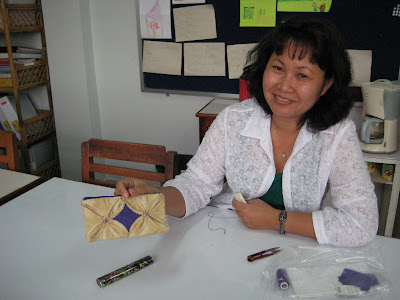
These stories are stories of a lost childhood... stories of an over-comer who is woman of God, a follower of Christ, a loving wife, a caring mother, a exceedingly grateful grandmother and a fabulous cook, seamstress and quilter.
Like Corrie ten Boom returning to Germany to share the Gospel of Jesus with her former Nazi captors, Thearey for returned to Cambodia to proclaim the freedom found in the message of Love and Forgiveness. She ministers joyfully to many here alongside her husband Bob.
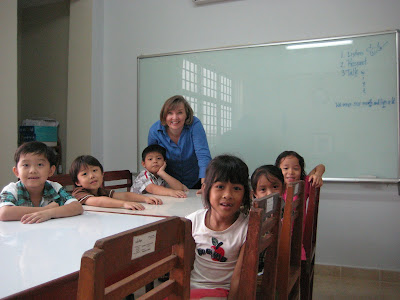
Bob is the 6th Grade teacher at Logos International School his student have a great time acting out biblical epics! see this link.
There are many stories yet to record... Bob and Thearey's romance is a gem! As is Thearey's arrival in America via the refugee camps of Thailand...
I'll be back sooner with follow up tales of wonder and adventure!








Recent Comments